There's a moment that happens through a telescope — usually Saturn, usually the first clear night after a new scope arrives — where a child goes completely quiet. Not bored-quiet. Processing-quiet. The rings are right there, impossibly clear, hanging in the dark. It's a three-dimensional object in space and they can see it with their own eyes. After a second or two they look up, then straight back into the eyepiece, then up again.
That moment makes astronomers. The hobby starts there, and for many people it never really stops.
The equipment question, then, is not "which telescope has the best specs" but "which telescope is most likely to produce that moment — and keep producing moments after it." The answers are different at different ages, and for different children. Here's how to get it right.
What age, what scope?#
Motor skills aren't there for fine focusing. Attention span is short. A scope they can't operate independently will need you every single time — and that gets old fast for both of you.
Old enough to focus, patient enough to hunt for objects, young enough that instant results still matter. A tabletop Dobsonian they can operate start-to-finish on their own is the sweet spot.
Ready for a proper 130mm Dob. Can handle collimation with guidance, enjoys the hunt of star-hopping, and will use the scope regularly without parental involvement.
The independence rating above is the critical variable. A telescope a child can't operate alone is one that requires you every single time — and that dependency erodes enthusiasm faster than bad optics. The best scope for a child is the one that removes you from the equation on night two.
The four scopes worth buying#
Everything below this list is a compromise that will be regretted. These aren't.
A 100mm tabletop Dobsonian that sits on any flat surface and needs zero assembly. The alt-azimuth motion is intuitive — point, look, adjust. Kids can operate this completely independently after five minutes.
- ✓ No tripod — no wobbly legs to fight
- ✓ Zero collimation needed
- ✓ Sharp views of Moon, Jupiter, Saturn rings
Needs a table or flat surface. Doesn't track. Included eyepieces are adequate but not exciting.
Same tabletop Dob philosophy as the 100P, but with 130mm of aperture — the point where deep sky objects reveal structure, not just glow. The clear first choice for any 12+ child who knows they're interested.
- ✓ Orion Nebula shows structure, not just a smudge
- ✓ Collimation easy once learned — a good life skill
- ✓ Still folds flat for storage
Needs occasional collimation. Heavier than the 100P. Focuser has some slop; fixable with grease.
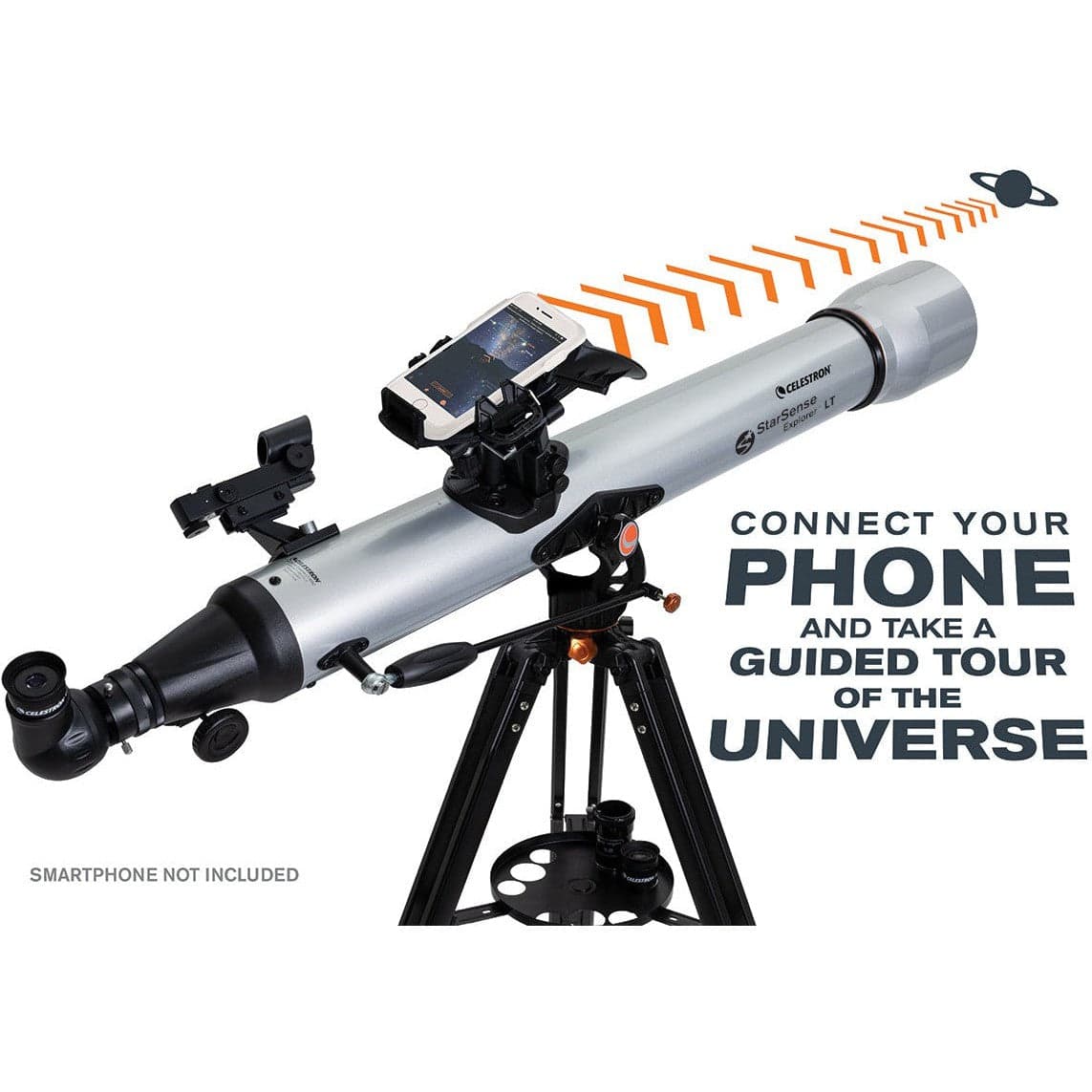
Mounts their phone over the eyepiece and uses star patterns to figure out exactly where the telescope is pointing. An on-screen arrow shows which way to move — no star atlas, no alignment ritual.
- ✓ Finds objects without knowing any astronomy
- ✓ No batteries, no motors, no alignment ritual
- ✓ Great for the 8–12 age group
80mm aperture limits deep-sky performance. Tripod is undersized — careful with heavier eyepieces.
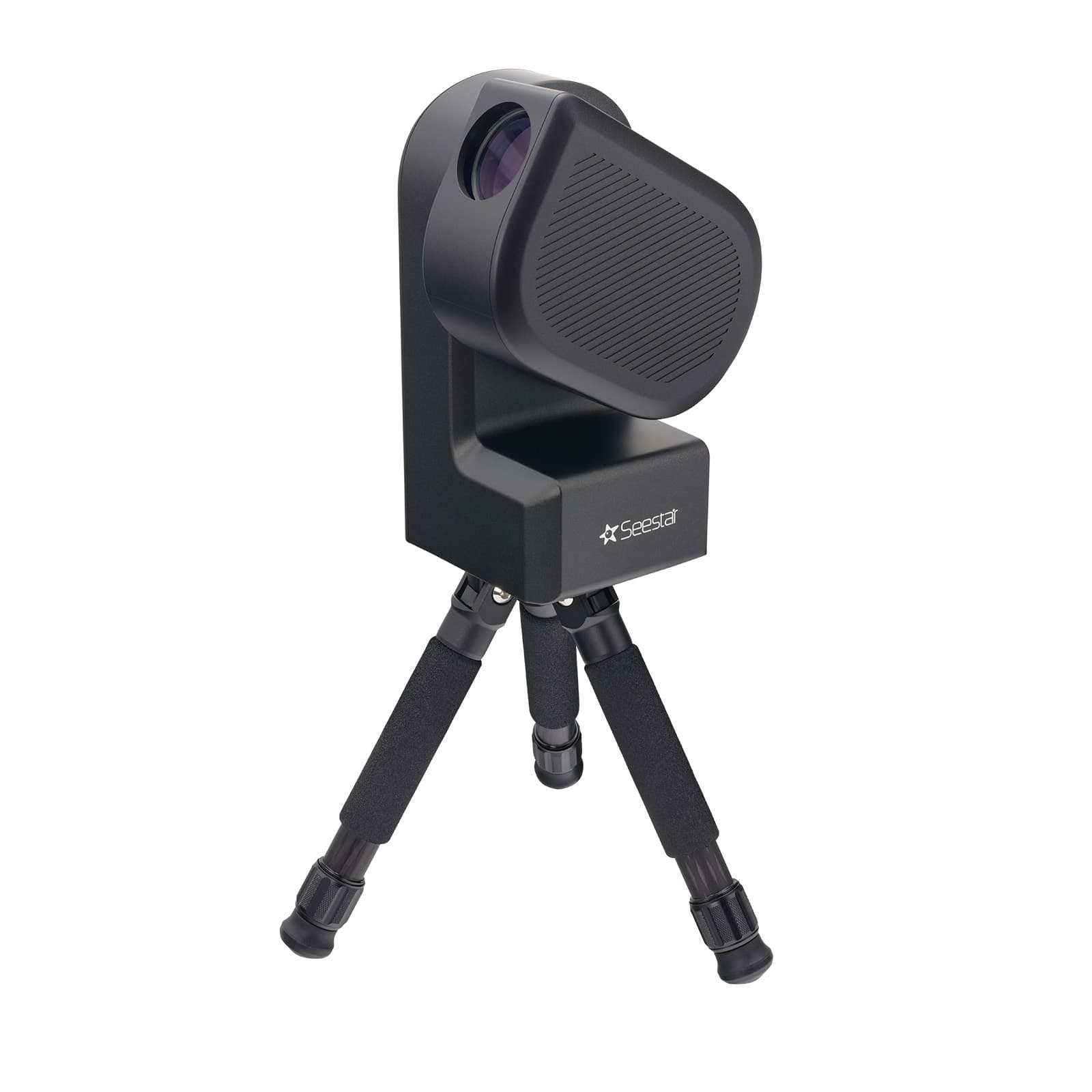
Point your phone at the sky, tap a target, watch it resolve on screen. No eyepiece, no focusing, no dark adaptation. Controversial among traditionalists — but for a child who wants results now, it genuinely delivers.
- ✓ Zero setup — nebula on screen in 5 minutes
- ✓ Shareable results; kids love showing friends
- ✓ Works from light-polluted suburban gardens
No eyepiece experience. Planets look better through a 130mm Dob. Premium price for 50mm aperture.
Owner reports on the Heritage 100P consistently highlight how well it arrives out of the box: multiple owners note that the scope came factory-collimated and needed no adjustment at all before first light. The Heritage 130P has a known focuser slop issue — applying a small amount of grease to the threads solves it in minutes, and it's worth knowing about before the first session so it doesn't become a first-night frustration.
The StarSense Explorer LT 80AZ has a weak point that owners consistently flag: the included tripod is undersized, and at high magnification there's a 3–4 second settle time after any movement. This is annoying for adults, but for a child using it to star-hop with the app at modest magnification, it's much less of a problem in practice.
Not sure which one?#
Question 1 of 3
How old is the child?
What they'll actually see#
Managed expectations are what keep a child engaged past the first week. The most common reason kids lose interest in a new scope is expecting Hubble Space Telescope images and getting something different. Here's the honest truth — which is still remarkable.
"The first time a child sees this — a real three-dimensional object hanging in the dark — they don't say anything for a second. Then they look again."
The Saturn moment is the hook. The rings are clearly resolved in a 100mm scope at modest magnification, and the Cassini Division — the gap between the A and B rings — becomes visible on a steady night. This alone justifies the purchase.
The Moon is spectacular at any aperture and never gets old. Every phase looks different. Craters, mountain ranges, the terminator line — it fills the eyepiece and children will return to it repeatedly.
Jupiter shows two dark equatorial cloud bands and all four Galilean moons in any 100mm+ scope. The moons move noticeably between sessions — one night later, they're in a different configuration. Children who notice this tend to notice a lot of other things too.
The Orion Nebula (M42) is visible as a glowing cloud even from suburban skies. Through a 130mm scope on a reasonable night, the four Trapezium stars at its heart are distinguishable and the surrounding nebulosity shows structure. Through a 100mm scope it's still a striking object, just less detailed. Don't build this one up too much before they see it — it's genuinely impressive but it isn't coloured, and that surprises some children who've seen processed Hubble images.
Galaxies and fainter deep-sky objects require dark skies and patience. From a suburban garden, most galaxies are faint oval smudges. This is fine — the Moon and planets will carry a new observer through the first year, and dark-sky trips become something to look forward to.
"They can grow into it"#
This is the most common mistake, and it comes from entirely reasonable logic. You don't want to buy a scope they'll outgrow in two years. So you buy something more complex — a GoTo mount, a tripod-mounted refractor with more features, an equatorial setup with tracking. They'll learn to use it.
Magnification beyond what the aperture supports enlarges blur, not detail. This is what "300×" on a 70mm lens delivers.
Sensible magnification matched to aperture. 130mm gathers 3.4× more light than 70mm. This is what actually works.
They won't. Or rather, they will only if you're there to help every single time — and that parental dependency is exactly what kills independent astronomical interest. The scope sits unused between sessions because starting it up requires an adult. By the time the child is old enough to use it properly, they've moved on to something else.
Simplicity is a feature, not a compromise. The Heritage 100P is a genuinely impressive instrument — not a beginner's toy. It delivers sharp views of the planets, it doesn't require setup beyond placing it on a table, and it never needs polar alignment or a two-star GoTo ritual. Astronomers with multiple telescopes use it regularly because it's easy. That ease is what gives a child the independence to observe whenever the sky is clear, without waiting for help.
Is the Seestar S50 right for a child?#
The Seestar S50 is genuinely different from everything else in this guide. There's no eyepiece. You point your phone at the sky, tap a target, and watch the image build on screen over 30 seconds as the scope stacks exposures automatically. It's operational within five minutes of opening the box.
For certain children, this is exactly right. A 12-year-old who is excited by results rather than process — who wants to show friends a real nebula photo from their garden — will love it. From a light-polluted suburban garden where a traditional scope struggles with faint objects, the Seestar's live-stacking cuts through the sky glow in a way a Dobsonian simply cannot.
The honest limits: the Seestar has a 50mm aperture and a fixed focal length. For planets, the Heritage 130P delivers more detail at a lower price point — Saturn's rings through a 130mm Dobsonian are sharper and more immediately satisfying than the Seestar's processed planetary output. Owner reports also flag software bugs that persist across updates; the app is mostly stable, but "mostly" and "for a child who will get frustrated and walk away at the first crash" aren't compatible.
The Seestar is a legitimate recommendation for an older child who is motivated by sharing results and doesn't care about the traditional eyepiece experience. It is not the right choice if planets are the primary goal, or if the budget would be a stretch.
What to avoid#
Toy store refractors
If the box says "magnifies 300×" and the aperture is under 70mm, it's a toy. Poor optics, a wobbly mount, and maddening focus make this the scope that turns kids off astronomy for good.
Department store refractors on tripods
A 60mm or 70mm refractor on a tall, wobbly tripod is the single most commonly gifted telescope. Small children genuinely cannot use this independently. It has two modes: can't find anything, and can't keep anything in view.
GoTo scopes for under-12s
GoTo systems require a two-star alignment ritual before they'll work. Get one star wrong and the scope will point confidently at nothing all night. Adults find this frustrating; children find it fatal to their interest.
Equatorial mounts without guidance
An equatorial mount that isn't polar-aligned is harder to use than an alt-azimuth. Without an adult who knows what they're doing, an EQ mount is actively hostile to a young beginner. Save it for when they ask.
The pattern with bad telescope purchases is consistent: a box that promises enormous magnification, a small aperture hidden in the small print, and a tripod that wobbles whenever you breathe near it. The magnification claim is meaningless — a 70mm scope at 300× produces an enlarged, dim blur. A 130mm scope at 100× produces something you'll actually want to look at. Aperture is what matters; magnification is marketing.