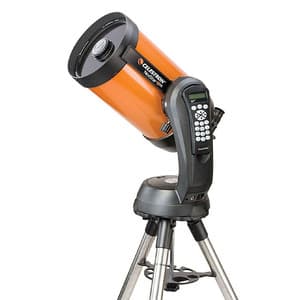
Planetary observing is where telescopes do their most dramatic work. The first time you see Saturn's rings — not as an oval smudge but as a clearly separated ring system around a striped disc — is the moment most people stop treating astronomy as a hobby and start treating it as a calling.
But planets are also merciless. A scope with mediocre optics, the wrong focal ratio, or poor seeing will turn a Saturn session into a blurry disappointment. Here's what actually separates a planetary telescope from everything else.
What makes a scope good for planets?#
Three things matter above everything else.
Long focal ratio
f/8 or longer is more forgiving of eyepiece imperfections and atmospheric turbulence. Short focal ratios (f/5 or below) are optimised for wide-field deep sky, not planetary detail.
Optical design
Maksutov-Cassegrains and SCTs are the planetary specialists. Their long folded focal paths and sealed tubes make them ideal for high-magnification work with minimal thermal interference.
Atmospheric seeing
Above ~150mm of aperture, the atmosphere becomes the limiting factor more often than the optics. A night of steady seeing is as important as which scope you own.
None of this means you need an expensive telescope. The right optical design at a modest aperture will outperform a cheap large reflector on planets, every time. This is where Maksutov-Cassegrains earn their reputation.
Saturn through different apertures#
Same planet, same night, different scopes. This is what changes as aperture increases.
What Saturn looks like at different apertures
70mm
Rings visible.
No Cassini division.
130mm
Cassini visible
in good seeing.
200mm
Clear Cassini. Belt bands.
Polar flattening.
Stylised illustrations. Views depend on seeing conditions, magnification, and eye adaptation.
At 70mm the rings are visible and unmistakably Saturn — but the view is soft. At 130mm the Cassini division becomes visible on good nights and the planet looks three-dimensional. At 200mm you're seeing cloud banding on Saturn and tracking individual belt features on Jupiter. Each step is a meaningful upgrade, not a marginal one.
Our picks#
These four scopes cover the realistic range from first planetary scope to serious amateur instrument. All are Maksutov or SCT designs for the reasons above.
Meade
ETX90 Observer
The best truly pocketable planetary scope. Small enough to travel, sharp enough to show Mars's polar caps. Not a first choice if you can stretch to 125mm, but nothing comes close for this level of portability.
Owners report tracking Mars's rotation over consecutive nights and resolving Syrtis Major at 480×. Higher contrast on planetary detail than some larger SCTs with more thermal mass.
Celestron
NexStar 5SE
The sweet spot for planetary beginners. 125mm of aperture at f/10 gives a long, forgiving focal length, GoTo alignment so you spend time observing not searching, and a system that grows with you as you add eyepieces.
Owners describe Ganymede as a globe at 250–300×, a Martian dust storm growing over successive nights, and GoTo placing Neptune dead-centre in the eyepiece on the first try.
Celestron
NexStar 6SE
25% more aperture than the 5SE for noticeably finer planetary detail — and real deep-sky capability when planets aren't well-placed. The go-to recommendation for anyone not on a tight budget who wants planets as the main event.
Owners report sharp planetary detail that holds up at 200× and beyond, and consistently recommend it for city and suburban use where light pollution is irrelevant for planets.
Celestron
NexStar 8SE
Eight inches of aperture in a package you can carry in one hand. On good seeing nights this is genuinely professional-grade planetary performance. The scope people upgrade to and stop upgrading.
Owners describe jaw-dropping lunar detail when thermally stabilised, and planetary views that outperform 4" refractors costing twice as much. Jupiter at 250× is a different experience.
The NexStar 5SE is the right scope for most people reading this. It has enough aperture to show genuine detail on all five bright planets, GoTo alignment works reliably, and it's compact enough to set up on a whim rather than treating it as a production. The 6SE and 8SE make sense if you know you're committed — the aperture difference is real and becomes more apparent as seeing conditions improve.
Work out your magnification before you buy#
Enter your scope's specs and any eyepiece to see what magnification you'll actually get — and whether it's within the useful range for your aperture.
Magnification
125×
Max useful mag
250×
Exit pupil
1mm
Good for planetary work
125× is a solid planetary magnification. Saturn's rings are clearly separated with the Cassini division visible in good seeing; Jupiter's belts are distinct. You have headroom — try a 7mm eyepiece on steady nights for more detail.
The maximum useful magnification (aperture × 2) is a theoretical ceiling. In practice, most planetary observing happens between 80× and 200× — high enough to reveal detail, low enough that the image stays bright and stable. The exit pupil figure tells you how much light reaches your eye; below 0.5mm you're working your scope hard and the atmosphere will limit you before the optics do.
Why Maksutov-Cassegrains dominate planetary lists#
Every pick above uses either a Mak or an SCT. Here's why the optical design matters so much for planets, and what each type does differently.
Refractor
Simple, sharp, low-maintenance. Best planetary refractors are 80–102mm f/9+. Good ones are expensive per mm of aperture.
Newtonian Reflector
Best aperture per pound. Open tube picks up thermals; short focal ratios (f/5–f/6) are less forgiving at high magnification.
Schmidt-Cassegrain (SCT)
Long effective focal length folded into a short sealed tube. The NexStar SE series. Excellent planetary performance, GoTo-ready.
Maksutov-Cassegrain
The planetary specialist. Meniscus corrector acts as both corrector and secondary. Ultra-long focal ratio, sealed tube, highest contrast at high magnification.
The Mak's key advantage is the all-spherical construction: every optical surface is easy to manufacture precisely. Combined with a long effective focal length in a compact tube — a Mak's focal ratio is typically f/12 to f/15 — you get high magnification from short eyepieces, minimal false colour, and a closed tube that protects the optics and reduces tube currents.
The trade-off is cool-down time. A Mak needs 30–45 minutes to reach thermal equilibrium with the outside air before the image fully settles. Set it up before dinner, let it cool, and it'll reward you with the sharpest views it can give. Rushing this step is the single most common reason new Mak owners are disappointed on their first night.
◉ A large Dobsonian (8-inch or more) will outperform a 5-inch Mak on planets when seeing is good — raw aperture wins. A Dob doesn't track, so you'll nudge the scope every 60 seconds at high power. For relaxed, extended planetary sessions, a driven mount is worth more than extra aperture.
The seeing problem#
The atmosphere is usually the limit — not your scope. Here's how to read the conditions before you start.
The Antoniadi Seeing Scale
Perfect — no quivering
Rare. Push the magnification. You'll see things your neighbours never have.
Slight undulations, calm periods
Good seeing. Push your magnification during the calm moments. Most productive planetary nights are here.
Moderate — some blurring
Average. Keep magnification moderate (100–150×). Still worth observing, but don't push it.
Poor — constant troublesome undulations
Low power only. A good night for the Moon, double stars, or star clusters.
Very bad — almost impossible to use
Don't observe planets. The scope is fine — the night isn't.
Good seeing forecasts: Astrospheric (iOS/Android), Clear Outside (UK-focused). Check before you set up.
Most nights fall between III and IV. A genuine Antoniadi II night — where a 5-inch Mak at 200× shows a steady, sharp Saturn — is something to plan around. When the seeing is poor, drop magnification and use a wider eyepiece: a shimmering 100× view shows more than a boiling 200× view.
Practical indicators: if stars near the horizon are twinkling furiously, seeing is poor. Stars near the zenith holding steady? Worth trying higher power. Jets and weather fronts are your enemy; high-pressure systems over the Atlantic are your friend.
Which planets are worth targeting?#
Not all planets reward the same amount of effort.
Moon
Any aperture · Always rewardingCraters, mountain ranges, the terminator shadow — even a 70mm scope delivers jaw-dropping lunar detail. Low magnification (50–80×) for full-disc views; high (150–200×) for crater floors and rilles. Always the show-stopper for guests.
Saturn
80mm+ · Rings always visibleThe crowd-pleaser. At 50× the rings are clearly separated from the disc. At 130mm+ in good seeing, the Cassini division appears as a dark gap. 200mm shows cloud banding and the shadow of the rings. Titan visible as a dot.
Jupiter
80mm+ · Rewarding at any apertureThe North and South Equatorial Belts are visible at 70mm. The Great Red Spot takes 100mm+ and good seeing. The four Galilean moons are easy — watch them shift position night to night. At 200mm+ on a good night, Ganymede resolves as a disc.
Mars
130mm+ · Good near opposition onlyDisappointing except near opposition (roughly every 26 months). At opposition with 130mm+: polar cap, dark Syrtis Major, surface markings. Outside opposition, just a small orange disc. Know when the next Mars opposition is before buying for Mars.
Venus
Any aperture · Phases onlyVenus shows phases like the Moon — interesting in itself (Galileo used this to disprove the geocentric model). No surface detail: Venus is permanently cloud-covered. Bright enough to view in daylight. Good first target for new owners.
Mercury
Difficult · Twilight onlyAlways low on the horizon in twilight — bad seeing and atmospheric distortion. Phases visible; that's about it. Worth a look as a tick on the list. Challenging to find without GoTo.
Uranus & Neptune
Disc only · GoTo strongly recommendedBoth show as tiny discs — Uranus is aquamarine, Neptune blue-grey. No surface detail at any amateur aperture. Worth finding once for the novelty (you're looking at an object over 2 billion miles away). GoTo is almost essential to locate them.
Saturn and Jupiter are the showpieces — always worth pointing the scope at, even on mediocre nights. Mars is rewarding only near opposition (every ~26 months) when it's large enough to show polar caps and surface markings. Venus shows phases but no surface detail — it's cloud-covered. Mercury is best observed in twilight and shows a tiny gibbous disc. Uranus and Neptune are possible but essentially featureless at amateur apertures — finding them is the achievement.
What to avoid#
Scopes advertised by magnification
If the box says "450× Power!" that's a red flag. Maximum useful magnification is determined by aperture — 2× per mm. A 60mm refractor is useless at 450×. These scopes have cheap wobbly mounts and poor eyepieces that produce blurry, dim images at any magnification.
Short focal ratio Newtonians for planetary
A fast Newtonian (f/5 or f/4.5) is a great deep-sky scope. For planets, you need high magnification — and fast focal ratios require expensive, well-corrected eyepieces to deliver a sharp image at 200×. An f/10 SCT will beat an f/5 Newtonian for planetary detail every time, with a budget eyepiece.
Cheap 2× Barlow on the included eyepiece
New owners slap a cheap 2× Barlow on the 25mm kit eyepiece to "get more magnification" and get a blurry mess. Invest instead in a good dedicated planetary eyepiece — 8–10mm for medium magnification, 6mm for high power on steady nights. Eyepiece quality matters as much as the scope.
Smart scopes for planets
Smart scopes like the ZWO Seestar are genuinely brilliant for deep-sky astrophotography. For planets, the small aperture, short focal ratio, and fixed camera sensor are not optimised for high-magnification planetary work. If planets are your primary goal, buy a Mak or SCT.
Frequently asked questions#
Planetary viewing is the branch of amateur astronomy that rewards patience most directly. A mediocre night spent watching Jupiter at 120× is still an extraordinary thing — four moons moving in real time, cloud bands crossing the disc. A rare night of Antoniadi I seeing, when Saturn at 200× looks like a photograph, is genuinely shocking in the best possible way. You only need one clear night with the right scope to understand why people spend decades on this.