Most telescope advice starts with aperture — the size of the mirror or lens. That's not wrong. But it skips something more important.
The mount is how you move the telescope, how you find things in the sky, and — once you've found something — how you keep it in view as Earth rotates underneath you. A great telescope on the wrong mount is a frustrating experience. A modest telescope on the right mount can be a joy to use.
There are really only four things to understand: alt-azimuth mounts, Dobsonians, equatorial mounts, and GoTo. Once those click, every telescope listing makes sense.
Why the mount matters more than you think#
The optics in a telescope are hard to mess up at consumer price points. A 130mm Newtonian from any reputable brand will show you Saturn's rings, Jupiter's cloud bands, and the Orion Nebula's core. The differences in optical quality between brands are real but subtle.
The mount, by contrast, affects every single moment you spend at the eyepiece. Can you find objects quickly? Does the image shake when you nudge the focuser? Can you follow a planet across the sky without constantly readjusting? Does setup take two minutes or twenty?
The most common reason beginners give up on astronomy is a wobbly, confusing, or underpowered mount — not bad optics. Understanding what each mount type offers before you buy is the most important decision you'll make.
The four mount types#
Alt-Azimuth
Moves left-right and up-down. Simple setup, no alignment needed. Used on most beginner and GoTo scopes.
Dobsonian
Alt-az rocker box sitting on a ground board. Stable, simple, and allows large mirrors at low cost.
Equatorial
Polar axis tilted to match your latitude. Tracks stars with one-axis movement. Essential for astrophotography.
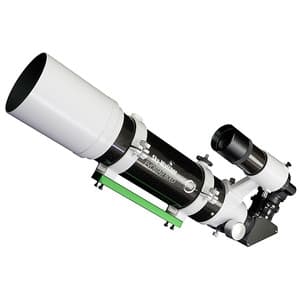
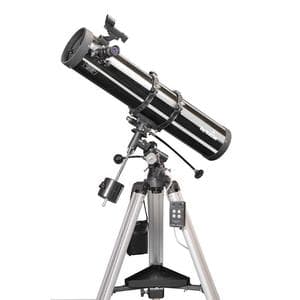
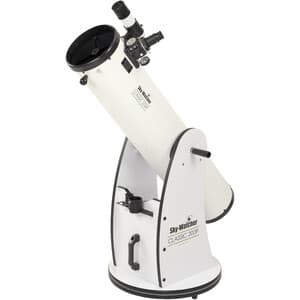
The three diagrams above show the three physical mount designs. The amber arrows show the motion axes — how the mount actually moves. GoTo is a motorised computer layer that can sit on top of either an alt-az or equatorial mount — it doesn't define a separate mechanical design, but it changes the experience significantly enough to deserve its own section.
Alt-azimuth — the intuitive one#
Alt-azimuth stands for altitude-azimuth: one axis moves the telescope up and down (altitude), the other sweeps it left and right (azimuth). If you've ever used a camera on a pan-tilt tripod, you already understand alt-az mounts. It works exactly the same way.
This simplicity is a genuine advantage on night one. You pick up the telescope, point it at the Moon, and you're looking in under two minutes. No alignment procedure, no axis to polar-align, no counterweights to balance. You loosen the clutches, point, tighten, and look.
The limitation becomes apparent once you want to track something. As Earth rotates, objects drift through the eyepiece. On an alt-az mount, following them requires nudging the scope in both axes simultaneously — because the celestial sphere rotates at an angle relative to your horizon. It's not difficult, but it's a constant manual task.
◉ Alt-az mounts with GoTo tracking do compensate for this automatically — but they introduce field rotation, where the image slowly spins as the two motors work together. Fine for visual observing, but it makes long-exposure deep sky photography impossible. If you're planning to image, an equatorial mount is the right tool.
Best for: beginners who want simplicity first, casual observers, planetary sessions where you're happy nudging the scope every few minutes, and smart telescopes like the Seestar S50 that handle tracking complexity in software.
Dobsonian — the aperture champion#
A Dobsonian is technically an alt-azimuth mount — the same two axes — but the design is completely different. Instead of a precision tripod head, a Dobsonian uses a simple rocker box that sits directly on the ground. The telescope tube pivots on bearings held by the box's side walls. That's it.
John Dobson invented this design in the 1960s specifically to make large-aperture telescopes practical for amateur astronomers on a real-world budget. It worked. Because there's no precision machined tripod head, no gearboxes, and no electronics, almost all the cost goes into the optical tube. The result: a 200mm mirror at a price where other designs would give you 100mm.
Tabletop Dobsonians — like the Sky-Watcher Heritage 130P — sit on any flat surface. Full-size Dobsonians like the Skyliner 200P stand on the ground and need you to crouch or use a step stool as targets move higher in the sky.
Best for: anyone who primarily wants to observe — the Moon, planets, star clusters, galaxies, nebulae — and wants the most optical performance for their budget. The Dobsonian is the right choice for most beginners who aren't planning to do astrophotography.
Why objects drift — and how tracking fixes it#
Why objects drift — and how a tracking mount fixes it
Understand this and the rest of the guide falls into place on its own.
Earth rotates — and every object in the sky moves with it.
This is obvious during the day — the Sun rises and sets. At night the same thing happens with every star and planet you're trying to observe. Point your telescope at Saturn and wait ten minutes without touching it. Saturn will have drifted noticeably toward the edge of your eyepiece.
Saturn drifts from the centre of your eyepiece to the edge — and beyond — in just a few minutes at moderate magnification.
You nudge the scope. It overshoots. You nudge it back. All session.
The RA motor rotates at exactly the same speed as Earth — opposite direction. Saturn stays pinned at the centre.
You can take your hands off the telescope entirely. This is what makes long-exposure photography possible.
One alignment. One motor. Tracks forever.
The RA axis is tilted to point at Polaris — the same direction as Earth's own rotation axis. A single motor rotates the RA axis at one revolution per 24 hours, exactly counteracting Earth's rotation. Your target stays pinned in the eyepiece indefinitely.
Polar alignment — Point the RA axis at Polaris. Takes 2–5 minutes at the start of a session. More precise alignment = better tracking for long exposures.
Dec axis — The second axis, perpendicular to RA. Used to point at different parts of the sky — not for tracking.
No field rotation — Because the tracking axis mirrors Earth's rotation exactly, the view stays upright in the eyepiece. Essential for astrophotography.
Equatorial — the serious one#
Now that you understand tracking, equatorial mounts make complete sense. The RA axis is tilted to point at the celestial pole — at Polaris in the Northern Hemisphere — and a single motor rotates that axis at one revolution per 24 hours, exactly counteracting Earth's rotation. Your target stays locked in the eyepiece indefinitely, hands-free.
Equatorial mounts do require more setup than alt-az. You need to polar-align at the start of each session, and you need to balance the optical tube using a counterweight on the Dec axis. Neither step is complicated — both become quick and routine after a few nights — but setup does take 5–15 minutes rather than 1–2.
Mount quality varies enormously across price points. The EQ2 supplied with budget telescopes like the Explorer 130M tracks imprecisely and feels flimsy. A mid-range mount like the HEQ5 Pro tracks accurately enough for deep sky astrophotography with exposures of several minutes. Higher-end mounts (EQ6-R and above) are needed for serious long-exposure work. The rule you'll hear from every experienced imager: the mount is where you spend your budget, not the optical tube.
Best for: anyone who wants smooth hands-free tracking during visual sessions, and essential for astrophotography beyond planetary snapshots. If you know you want to do long-exposure deep sky imaging, start here from the beginning — even a modest equatorial setup sets you up for the right upgrade path.
GoTo — what it does and doesn't solve#
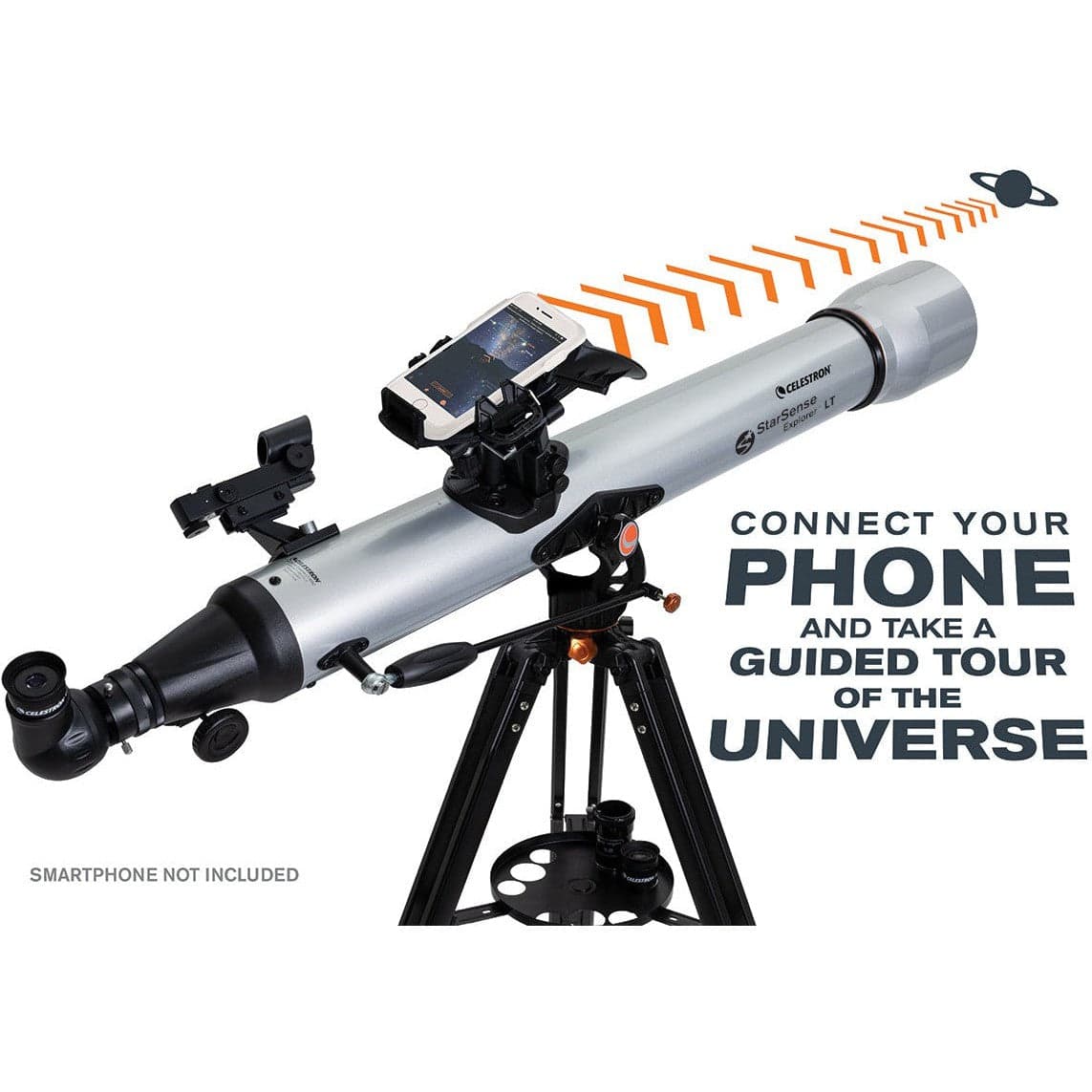
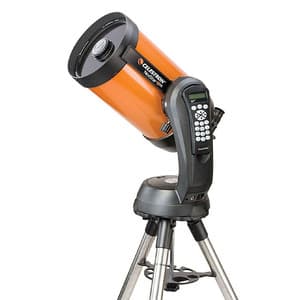
GoTo is a motorised system with a computer handset (or phone app) that stores a database of thousands of objects. After an alignment procedure — typically pointing the scope at two or three known stars and confirming you've got the right ones — you select M13 in Hercules from a menu and the mount rotates there automatically.
For experienced observers working through a target list efficiently, GoTo is genuinely useful. For beginners, the reality is more complicated than the marketing suggests.
The alignment procedure sounds trivial but catches people out. You centre a star in the eyepiece, confirm it, move to a second star, confirm it. If you misidentify either star — common when you're new to the sky — the mount points confidently at nothing all night. Troubleshooting this in the dark, with a cold focuser and dew forming on the eyepiece, is the experience that turns people off GoTo for life. It gets much easier once you know your way around the sky. Which is exactly when you'd need it least.
| What GoTo does | What GoTo doesn't solve |
|---|---|
| Slews automatically to any named object | Still needs a 3–5 minute alignment ritual |
| Tracks objects to keep them in view | Doesn't improve the optics at all |
| Saves time for experienced observers | Doesn't teach you the night sky |
| Works well for outreach sessions | Adds £100–£400 to the price |
The honest beginner recommendation: skip GoTo for your first telescope. The same money buys meaningfully more aperture on a Dobsonian, and learning to navigate the sky manually — using a star atlas or a planetarium app to guide your eyes — is one of the most satisfying parts of the hobby. You understand the sky differently when you've had to find things yourself. GoTo becomes much more useful once you know what you're looking for.
Which mount do you actually need?#
The table above summarises the key differences at a glance. In practice, most decisions come down to three questions in sequence — astrophotography first, then GoTo, then aperture vs simplicity:
Are you planning to do astrophotography?
Long-exposure deep sky images — not just phone snapshots of the Moon.
HEQ5 Pro or similar. Budget as much on the mount as the optical tube.
Do you want the scope to find objects automatically?
Worth the alignment ritual and cost premium — or would you rather learn to navigate manually?
NexStar SE or Evolution. Automated finding, visual-only tracking.
Do you want maximum aperture for your money?
A larger mirror shows more sky. Or do you prioritise portability and simplicity?
If you're still not sure, answer three quick questions:
Question 1 of 3
What do you most want to do with your telescope?
One last thing#
The right mount doesn't just affect what you can do — it affects whether you actually go outside and use the telescope. A Dobsonian that sets up in two minutes gets used. An equatorial that takes 20 minutes to set up, align, and balance tends to stay in the cupboard unless you're sufficiently motivated. Be honest about that when you're choosing.
Most beginners are better served by the simpler mount. You can always upgrade later — and by then you'll know exactly what you're upgrading to and why.