Why telescopes are actually hard to build#
Light is awkward. It travels in straight lines, but it bends when it passes through glass — and it bends differently depending on its colour. Red light bends a little. Blue light bends more. Pass white starlight through a cheap lens and you don't get a sharp point of light at the focal plane; you get a point surrounded by a faint rainbow fringe. That's chromatic aberration, and it's the reason telescope lenses have cost serious money for 400 years.
Mirrors avoid that problem — they reflect all wavelengths equally — but introduce their own headaches. A parabolic mirror (the shape needed to bring all incoming light to a single focus) has to be ground and polished to tolerances measured in fractions of a micron. A single primary mirror in a £200 Dobsonian has been shaped more precisely than almost any other object you own. Even then, the slightest misalignment between mirror and eyepiece — collimation — smears the image.
Then there's diffraction. Light waves bend around the edges of any aperture — including the rim of a telescope's mirror or lens. This means even a perfect telescope can't produce a perfectly sharp point of light. A star focuses to a tiny disc (the Airy disc) surrounded by faint concentric rings. The only way to make that disc smaller, and thus resolve fine planetary detail or separate closely-spaced double stars, is to use a larger aperture. Physics sets the limit. Engineering gets you as close to it as your budget allows.
And the telescope itself isn't even the biggest obstacle. The atmosphere is. On any given night, columns of air at different temperatures are drifting across your line of sight, bending the light slightly as they go. This is atmospheric "seeing," and on a bad night it ruins high magnification no matter how good the telescope is. Learning to read the sky — to recognise when the seeing is good enough to push the magnification up — is one of the most important skills you'll develop as an amateur astronomer.
All of this is why the numbers on a telescope's spec sheet aren't arbitrary marketing. They're the fingerprints of these physical constraints, and understanding what each one represents makes every purchasing decision much clearer.
What makes focusing light difficult
Chromatic Aberration
Diffraction Limit
Two physical reasons why building a telescope well is genuinely difficult
What a telescope actually does#
Before diving into individual specs, it helps to understand what a telescope is trying to do. Every telescope — regardless of type, price, or design — has exactly three jobs:
- Collect light — gather as many photons as possible from a dim, distant object
- Bring that light to a focus — converge it to a point (or as close to one as physics allows)
- Magnify that focus — spread the focused image out so your eye can see detail in it
Most beginners think of magnification as the main point. It isn't. Light collection comes first, and by a large margin. Saturn is bright enough that even a 60mm refractor can show you the rings. But a faint globular cluster — a ball of a hundred thousand stars 25,000 light years away — gives off so little light that a 70mm scope shows only a fuzzy smudge. A 200mm scope, collecting eight times more light, begins to resolve it into individual stars. That experience — the moment a fuzzy blob becomes a glittering sphere — is simply not available to small apertures regardless of how much magnification you apply. No eyepiece fixes a dim image; you can only magnify what the telescope has collected.
Every spec on the box maps directly to one of these three jobs. Aperture governs collection. Focal length governs how the focus is formed. Magnification is produced by the eyepiece working on the focused image. Understanding the chain makes each spec feel like a consequence of physics rather than a number someone picked.
The three jobs, illustrated
Every spec on the box is a measure of how well the telescope does one of these three jobs
Aperture — the number that matters most#
Aperture is the diameter of the telescope's primary lens or mirror — the opening that gathers light. It's measured in millimetres and it's the single most important number on any telescope's spec sheet.
Why does it dominate everything else? Because light-gathering scales with area, and area scales with the square of the diameter. A 200mm telescope doesn't gather twice as much light as a 100mm one — it gathers four times as much. A 300mm scope gathers nine times more than a 100mm. More light means you can see fainter objects, resolve finer detail, and work at higher magnifications before the image becomes dim and mushy.
Aperture also determines resolving power — the ability to distinguish fine detail. The Dawes limit gives a rule of thumb: maximum resolution in arc-seconds ≈ 116 ÷ aperture in mm. A 130mm scope can theoretically resolve detail as fine as 0.89 arc-seconds. A 70mm scope is limited to about 1.66 arc-seconds. In practical terms: the 130mm scope can split closely-spaced double stars and show fine detail in Jupiter's cloud belts that the 70mm simply cannot, regardless of what eyepiece is fitted. Magnification can spread the image larger, but it can't create detail that the aperture hasn't resolved.
Experienced amateur astronomers have a saying: "aperture wins." It's a slight oversimplification — mount quality, eyepiece quality, and atmospheric seeing all matter — but it captures something real. Given roughly equal quality in everything else, bigger aperture produces a better view. Always.
The catch is that more aperture means more telescope: heavier, longer, harder to set up, and more expensive. A 12-inch Dobsonian will show you things that will take your breath away — but if it lives in a garage because setting it up is a 30-minute commitment on a cold night, it loses to the 5-inch scope you actually take outside. The game is finding the largest aperture you'll use regularly. That answer is different for everyone, and honest self-knowledge about your patience and storage situation is more useful than any spec chart.
Light-gathering area by aperture
Circles are drawn to scale — the area represents how much light each scope collects
A 300mm mirror collects 18× more light than a 70mm lens — enough to reveal objects invisible to the smaller scope
Focal length and focal ratio#
Focal length is the distance (in millimetres) that light travels from the primary lens or mirror to the point where it comes into sharp focus. A telescope described as "130mm f/5" has a primary mirror 130mm across and a focal length of 650mm — the effective light path inside the telescope is 650mm long, even if the physical tube is shorter.
On its own, focal length tells you the telescope's magnification potential when combined with a given eyepiece. Longer focal length = higher magnification for any given eyepiece. But focal length in isolation doesn't tell you much. What matters is how it relates to aperture.
That relationship is the focal ratio: focal length divided by aperture. A 130mm scope with a 650mm focal length has a focal ratio of f/5 (650 ÷ 130 = 5). A 90mm scope with a 1250mm focal length is f/14. The f/ number is one of the most useful single-number descriptors of a telescope's character, because it tells you simultaneously about field of view, physical size, and eyepiece demands.
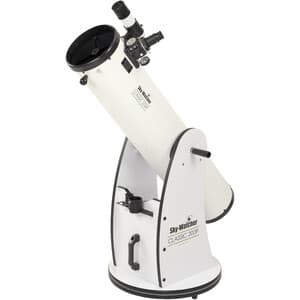
Fast scopes (f/4–f/6) have wide, bright fields of view — excellent for sweeping star clusters and large nebulae. They're physically compact for their aperture: a 200mm f/5 scope has a 1000mm tube, manageable in a Dobsonian. But they're demanding on eyepieces. At fast focal ratios, the cone of light converging toward focus is steep, and cheap eyepieces struggle to maintain sharp focus across the full field. Stars near the edge of view can look like little comets or seagulls — an optical defect called coma. A mid-range eyepiece like a BST Starguider handles f/5 well. Genuinely cheap plastic eyepieces will frustrate you.
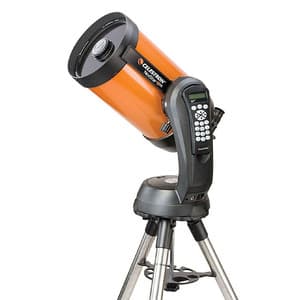
Slow scopes (f/10–f/15) produce a narrower field but are remarkably forgiving on eyepieces. The shallower converging cone is easy for almost any eyepiece design to handle. Schmidt-Cassegrains (like the Celestron NexStar 8SE) typically run at f/10. Maksutov-Cassegrains are often f/13–f/15. Their long effective focal lengths mean you reach high magnification with commonplace eyepieces — a 10mm eyepiece on a 2000mm focal length scope gives 200×, without needing anything exotic.
Neither is objectively better. Fast focal ratios suit wide-field observing and a grab-and-go lifestyle. Slow focal ratios suit high-magnification planetary work. Many experienced observers own both types.
Focal ratio spectrum
Coma-prone · Compact tubeNarrow field · Planetary detail
Forgiving on eyepieces · Long tube
Neither end is “better” — fast scopes suit wide-field observing, slow scopes suit planetary work
Magnification — the most misunderstood spec#
Here's the thing most beginners don't realise: magnification is not a fixed property of a telescope. It's a property of the combination of telescope and eyepiece. The same telescope can produce 30×, 80×, 200×, or 400× depending on which eyepiece you put in it.
The formula is simple: magnification = scope focal length ÷ eyepiece focal length. A 900mm scope with a 25mm eyepiece gives 36×. Swap in a 9mm eyepiece and you get 100×. Swap in a 4mm eyepiece and you get 225×. This is why the eyepiece collection you build matters as much as the telescope itself — you're effectively building a set of different magnifying powers for the same scope.
This is also why "500× zoom!" printed on a box is a red flag, not a selling point. Any telescope can technically reach very high magnification; you just need a short enough eyepiece. What limits useful magnification is aperture. A rough but reliable rule of thumb: the maximum useful magnification is roughly 2× the aperture in millimetres. For a 130mm scope, that's about 260×. Beyond that, the Airy disc is being magnified faster than any new detail is being revealed, and you're spreading a fixed amount of light over a larger area — which makes the image dimmer, not better.
But here's the thing that surprises many new observers: high magnification also demands atmospheric cooperation. The Earth's atmosphere is constantly in motion. On most nights, thermal turbulence in the air above you — not the telescope, not the eyepiece, but the air itself — limits useful magnification far below the theoretical maximum. This is what astronomers mean by "seeing." A night of poor seeing caps you at perhaps 80–100× on any scope, no matter how good. On a rare night of exceptional seeing, you might push 300× on a 130mm scope and see detail that made the whole session worth staying up for.
Beginners tend to chase magnification because high numbers sound impressive. Experienced observers know that most of the best views happen at low to moderate magnification. Wide-field, low-power sweeping through the Milky Way with a 32mm eyepiece, the whole Pleiades cluster framed in a single view, stars sharp and cold against the black — there's no amount of magnification that makes that better. Use the calculator below to see exactly what any scope and eyepiece combination will produce, including the maximum useful limit for your aperture:
Telescope Specs Calculator
Enter your scope and eyepiece to see what you'll get
Diameter of the main lens or mirror
On the tube label or in the manual
Printed on the eyepiece barrel
Exit pupil — the beam your eye actually receives#
Exit pupil is the diameter of the beam of light that emerges from the eyepiece and enters your eye. It's not a spec you'll find on any telescope box, but it's one of the most practically useful numbers in amateur astronomy, and understanding it will improve your observing immediately.
The formula: exit pupil = aperture ÷ magnification (equivalently: eyepiece focal length ÷ focal ratio). A 130mm scope at 65× produces an exit pupil of 2mm. The same scope at 20× produces a 6.5mm exit pupil. The calculator above shows exit pupil alongside magnification — useful to keep an eye on both simultaneously.
Why does it matter? Because the human eye's pupil dilates to about 6–7mm in full darkness. If your telescope's exit pupil is larger than your dilated pupil, the outer ring of light is simply wasted — it hits the iris instead of entering the eye. Worse: a large exit pupil makes the sky background appear brighter, which crushes contrast on faint objects. Under light-polluted suburban skies especially, a large exit pupil (anything above 5–6mm) makes the sky appear grey rather than black, washing out dim galaxies and nebulae that need contrast to be visible.
At the other extreme, very small exit pupils (under 0.8mm or so) become difficult to use. The tiniest head movement or eye tremor causes the view to blink out — you're threading a needle every time you look through the eyepiece. There's a practical lower limit, and it's determined by your physical ability to hold your eye steady.
For practical purposes: if you're sweeping for objects under a dark sky, a 5–7mm exit pupil is ideal — wide field, bright image, easy to navigate. For general planet and cluster observing, 2–4mm is the sweet spot. For serious high-power planetary work on a steady night, 1–2mm is where you want to be.
The same star field at different exit pupils
All four views from the same 130mm scope — different eyepieces, different magnifications
Eye relief — especially important if you wear glasses#
Eye relief is the distance between the last optical element of the eyepiece and the point where your eye needs to be to see the full field of view. It's measured in millimetres and typically ranges from about 5mm (uncomfortable for most people) to 20mm+ (generous).
For most observers, 10–15mm is perfectly workable. If you wear glasses and observe with them on — which is usually recommended, since glasses correct for astigmatism that your eye can't compensate for by refocusing — you need at least 15–20mm of eye relief. With less than that, your eye simply can't get close enough to the eyepiece to take in the full field, and you'll see a dark ring around the edges of the view regardless of how you position your head.
Many inexpensive eyepieces, particularly the Huygens and Ramsden types that come bundled with entry-level telescopes, have notoriously short eye relief — sometimes as little as 5–8mm. This is one of the most common reasons beginners find their views awkward and tiring, even when the optics are fine. A decent quality Plössl or a wide-field design from BST, Baader, or Explore Scientific will have comfortable eye relief and make a night at the eyepiece much more enjoyable.
Reading a real spec sheet#
Everything above is abstract until you read a real spec sheet and start translating numbers into expectations. Let's do that with the Sky-Watcher Heritage 130P — the telescope that appears more often in "what should I buy?" threads on Cloudy Nights and Reddit than almost any other scope at its price point.
Before you look at the decoded table: notice that you now have a mental framework. Aperture = light collection. Focal length = magnification scale. Focal ratio = character and eyepiece demands. Mount type = how you'll move it and whether it tracks. Weight = how often you'll actually use it. Every row below will make sense in context.
Two things to notice. First: every optical spec connects to one of the three jobs. The 130mm aperture is the collection capability. The 650mm focal length defines the magnification scale. The f/5 focal ratio tells you the scope's character and what eyepieces to pair it with. Second: one spec links directly to our telescope mounts guide — because mount type is the single most consequential non-optical spec, and deserves its own deep dive.
What the table doesn't tell you: owner experiences on Cloudy Nights for the Heritage 130P consistently mention three things. The focuser knobs can be loose out of the box and benefit from tightening. Collimation drifts after transportation and needs occasional checking. And the included 10mm eyepiece is fine but the 25mm is much better for wide-field views. None of that is on the spec sheet. Which leads us to the specs that don't exist.
Specs that don't appear on the box#
The optical specs tell you what a telescope can do under ideal conditions, used by a competent observer with good eyepieces on a steady night. They describe the instrument in isolation. What they don't tell you is what the experience of actually owning and using this telescope will be like — and that gap is where most beginner disappointments live.
Mount quality — the number one beginner killer
A shaky mount makes every view frustrating. At 100× magnification, the slightest touch sends the image wobbling for seconds. Many budget telescopes pair decent optics with a wobbly tripod — the optics are fine, but the experience is miserable. When reading reviews, look for comments on stability before comments on optics. The Heritage 130P avoids this by using a solid Dobsonian base instead of a lightweight tripod.
Focuser quality — ignored until it isn't
The focuser controls the in/out movement of the eyepiece. A cheap rack-and-pinion focuser with no tension adjustment will drift — you achieve focus, then watch it slowly slide out while observing. A good focuser is smooth, holds position, and doesn't wobble. This spec exists nowhere on the box. Owner reviews on Cloudy Nights are the only way to know before buying.
Included eyepieces — usually mediocre
Budget telescopes typically come with one or two basic eyepieces with short eye relief and a narrow apparent field of view. A single decent aftermarket eyepiece — a 25mm Plössl for low-power views, or a 10mm BST Starguider — makes a bigger difference to the viewing experience than almost any other upgrade. Budget around £30–£50 / $40–$65 for a good first eyepiece upgrade.
Collimation — the maintenance spec
Newtonian reflectors need occasional collimation — alignment of the primary and secondary mirrors. An uncollimated scope produces soft, disappointing views even if the optics are fine. Learning to collimate takes about ten minutes once you're familiar with it, and a cheap collimation cap (around £10 / $12) is all the tool you need. It's completely invisible from the spec sheet.
This matters in a practical way when you're comparing two telescopes: one with slightly worse optics on a superb mount is often more enjoyable than one with better glass on a wobbly tripod. Owner forums know this, which is why mount quality comments appear in almost every telescope thread on Cloudy Nights even when the original question was about optics. Read those comments before you buy.
The other thing worth saying: a spec sheet describes a telescope as it arrived in the box. A telescope you've owned for six months — focuser tensioned, mirrors collimated, a couple of decent eyepieces in your kit bag — performs meaningfully better than the same model fresh from factory packaging. The specs don't change, but the experience does. Factor in a modest accessories budget when you're making the purchase decision, and buy the scope knowing you'll invest a little time in setting it up properly. The payoff is real.