What this budget actually gets you#
Three hundred pounds isn't a consolation prize. It's a genuinely good telescope budget.
At this price you can get 130–150mm of aperture on a stable, workable mount — enough to see Saturn's rings clearly, resolve Jupiter's four Galilean moons, pick out the Cassini division on a steady night, work through dozens of Messier objects from a suburban garden, and have moments that will stick with you for years.
What you don't get: GoTo. Motorised tracking. A mount you'd want to put a camera on. Those things start at £400–500 / $500–640 and the cheap versions at this price are genuinely not worth buying. The good news is you don't need any of them to have an excellent first scope.
| Target | 80mm | 100mm | 130mm | 150mm |
|---|---|---|---|---|
| Moon — craters & detail | Good | Excellent | Excellent | Excellent |
| Saturn — rings visible | Yes | Yes | Yes | Yes |
| Saturn — Cassini division | Rarely | Good seeing | Clearly | Clearly |
| Jupiter — cloud bands | Faint | Good | Excellent | Excellent |
| Jupiter — Great Red Spot | No | Hint | Yes | Clearly |
| M42 — Orion Nebula | Cloud/stars | Structure | Sweeping | Sweeping |
| M13 — globular cluster | Fuzzy ball | Edge stars | Resolving | Resolving |
| M31 — Andromeda core | Faint | Core glow | Core + halo | Core + halo |
Assumes clear suburban skies. Dark sky access improves deep-sky results significantly.
The table above shows why aperture matters. At 80mm, Saturn's Cassini division is a lucky sighting. At 130mm, it's routine on a decent night. At 150mm, Jupiter's Great Red Spot becomes a regular feature rather than a faint smudge. The difference between 80mm and 130mm isn't subtle — it's the difference between "I think I can see something" and "I can actually see that".
Why this guide focuses on reflectors#
You'll notice this guide doesn't feature any refractors — the classic long tube with a lens at the front. That's a deliberate choice.
Refractors are optically clean and low-maintenance. A good 80mm refractor gives sharp planetary views with no collimation needed. The problem is that at this budget, 80mm is roughly what you can afford in a refractor. For the same £200–250, a 130mm Dobsonian gathers more than twice the light.
◉At £200–£300 / $255–$380, a reflector or Dobsonian gives you 2–3× the aperture of a comparably priced refractor. Aperture is the single biggest driver of what you can see. The maths almost always favours the mirror.
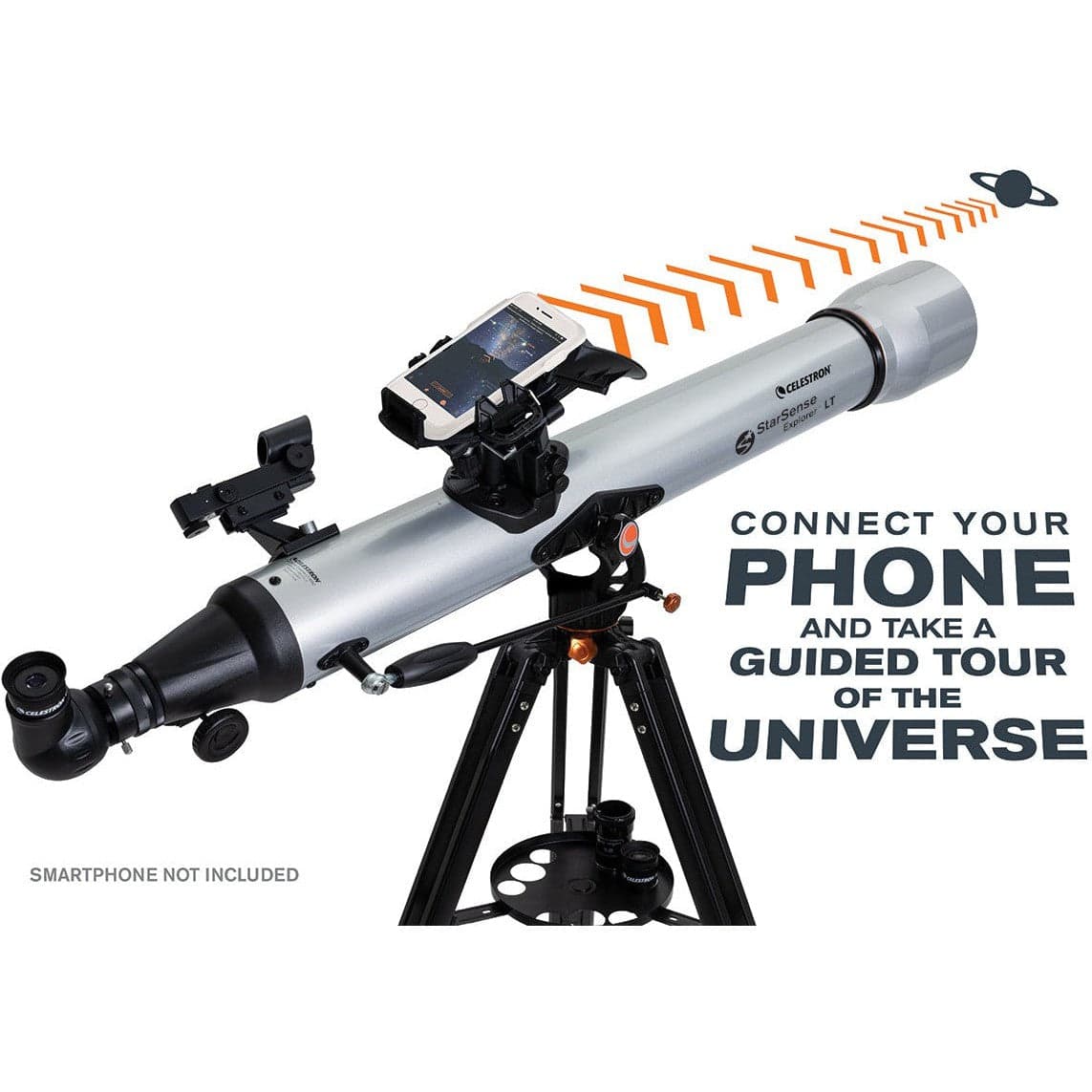
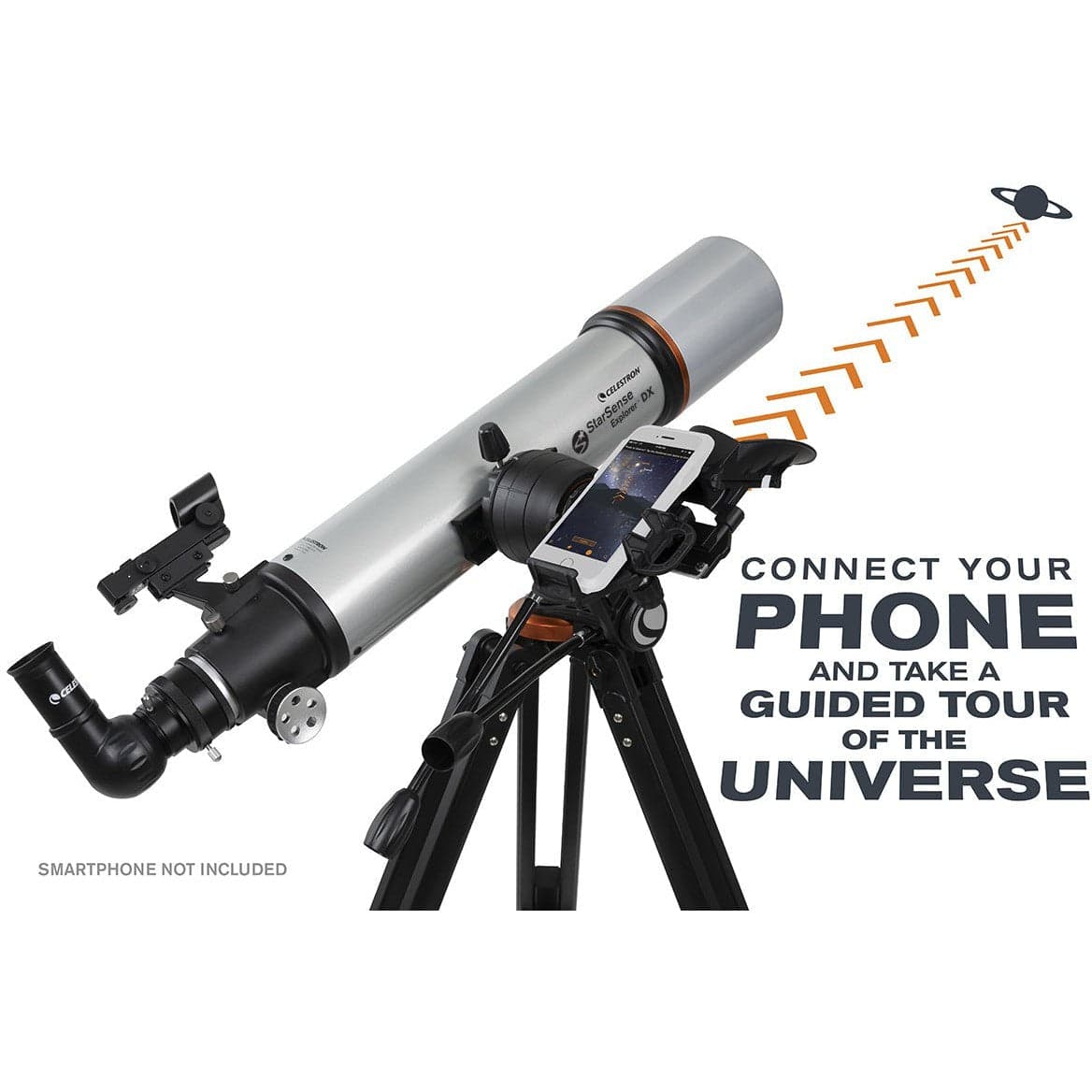
The one exception is the StarSense Explorer range — those use a refractor with Celestron's phone-assisted pointing system. We've included them for buyers who want help finding objects and are happy with the aperture trade-off. For everyone else, reflectors and Dobsonians are the right answer at this price.
Three directions#
Even within this budget, the right scope depends on what you want. Before the picks, choose your direction:
Maximum aperture
You want the best possible views. Setup complexity doesn't bother you and you're happy learning to star-hop.
Best picks
Heritage 130P
Skyliner 150P
Help finding objects
Star-hopping sounds frustrating. You'd rather the phone app show you exactly where to point — and spend your time actually looking.
Best picks
StarSense Explorer DX 102AZ
StarSense Explorer LT 80AZ
Learning the mount
You want to understand polar alignment and tracking — a foundation you can build astrophotography on later.
Best pick
Explorer 130M
If you want the best views and are happy to spend an evening learning to star-hop, the Heritage 130P or Skyliner 150P is your answer. If you want the phone to do the navigation so you can spend your time observing, the StarSense Explorer is the right choice. If polar alignment and tracking is part of the plan — because astrophotography is on the horizon — the Explorer 130M is the scope to get comfortable on.
Our picks#
Six scopes, all available under £300 / $380. Ordered by recommendation strength.
Sky-Watcher Heritage 130P
130mm f/5 Dobsonian · tabletop
~£190 / $240
Full review →Owners report seeing Jupiter, its moons, Mars, and Saturn's rings right out of the box on night one.
Strengths
- +Most aperture at this price
- +Collapses to bag size
- +Zero setup — ready in 2 minutes
One thing to know
–Needs a table or box to stand on — no floor tripod included
Sky-Watcher Skyliner 150P
150mm f/8 Dobsonian · floor-standing
~£230 / $295
Full review →Strengths
- +150mm gathers more light than the 130P
- +Floor rocker box — no table needed
One thing to know
–Bulkier to store and transport
Sky-Watcher Explorer 130M
130mm f/9 Newtonian · EQ2 mount
~£220 / $280
Full review →Strengths
- +Equatorial mount teaches you how the sky moves
- +Motor-upgradeable for tracking later
One thing to know
–EQ mount has a steeper learning curve than a Dobsonian
Celestron StarSense Explorer DX 102AZ
102mm f/6.5 refractor · Alt-Az · phone-assist
~£250 / $320
Full review →First-night owners report seeing Jupiter's colour bands even as a complete beginner.
Strengths
- +Phone app shows exactly where to point — no star-hopping
- +No alignment routine, no batteries needed
One thing to know
–102mm — less aperture than the 130mm reflectors
Celestron StarSense Explorer LT 80AZ
80mm f/5 refractor · Alt-Az · phone-assist
~£160 / $200
Full review →Owners report better views than similarly-priced alternatives, even for complete beginners.
Strengths
- +Same phone-assist as the DX at a lower price
- +Good Moon and planet views
One thing to know
–80mm is the narrowest aperture in this guide
Sky-Watcher Heritage 100P
100mm f/4 Dobsonian · tabletop
~£110 / $140
Full review →Strengths
- +Genuinely pocketable — fits in a rucksack
- +Same optical quality as the 130P in a smaller package
One thing to know
–100mm is noticeably less than 130mm on faint deep-sky targets
A note on the picks: The Heritage 130P is the right scope for most people reading this — it's the most-recommended first scope on Cloudy Nights, and the community consensus is consistent. The Skyliner 150P is worth considering if you have the full budget and portability isn't a priority; 150mm is a noticeable step up on faint deep-sky targets. The StarSense Explorer options are for buyers who know they'll struggle with star-hopping or are buying as a gift. The Explorer 130M is specifically for the patient buyer who wants to learn the equatorial mount properly, with one eye on imaging later. The Heritage 100P is for the buyer with a hard budget ceiling or who genuinely needs bag-sized portability.
One comparison worth noting: if you're choosing between the Heritage 130P and the Explorer 130M, read the Heritage 130P vs Explorer 130M comparison — the difference in mount type is more significant than the aperture similarity suggests.
What to avoid at this budget#
Refractors marketed on maximum magnification
If the box says "525× Power" and costs £50–£100, put it down. These scopes have small lenses, poor coatings, and plastic focusers that wobble. The magnification claim is physically meaningless — you'd need a very large aperture to use it. Views through these scopes put people off astronomy for life. Stick to Sky-Watcher, Celestron, or Meade.
Cheap GoTo mounts at this price
GoTo under about £400 / $500 means flimsy plastic gearing, inaccurate motors, and a star-alignment routine that frustrates beginners into giving up. The Celestron NexStar 130SLT starts at around £500 and is the entry point for GoTo worth buying. At this budget, skip it — you'll get a better scope and better views with a manual Dobsonian.
Department store and supermarket scopes
These appear at Christmas in Aldi, Lidl, and Costco — and they're almost never from established astronomy brands. The optics may be passable; the tripod almost certainly won't be. A scope that vibrates for 10 seconds after you touch it is not usable. Established brands like Sky-Watcher and Celestron have known, reliable quality control at this price.
One more thing not on the list: the Celestron AstroMaster 130EQ. It's a common recommendation in gift guides and Amazon listings. The telescope itself is adequate — 130mm is decent aperture. But the EQ mount is a frustratingly poor first equatorial experience, with stiff controls and limited usability. If you want a Dobsonian, get the Heritage 130P. If you want an EQ mount, get the Explorer 130M. The AstroMaster sits in an awkward middle ground that serves neither goal well.
Getting the most from your scope#
The scope is only part of what makes a successful observing session.
Dark skies matter more than a better scope
A 30-minute drive to Bortle 4 skies will reveal more deep-sky objects than any upgrade you can make at this price. Light pollution is the constraint, not aperture. Find your nearest dark site — lightpollutionmap.info is excellent.
One better eyepiece transforms the view
The bundled eyepieces are functional but not the best. A second-hand Baader Hyperion 8mm or 10mm (around £40–60 used) makes a clear difference on planetary and lunar detail. It's the most cost-effective upgrade at this price.
Twenty minutes of dark adaptation
Your eyes need 20 minutes to fully dark-adapt after any white-light exposure. Going straight from a lit room will make everything look faint. A red torch preserves night vision; white light destroys it. The scope is fine — give your eyes time.
Collimation for reflectors — 5 minutes
The Heritage 130P and Explorer 130M may arrive needing collimation. It sounds intimidating; it isn't. A Cheshire eyepiece costs about £15 and makes it straightforward. The Sky-Watcher alignment guide and Cloudy Nights collimation thread are the standard references.
One specific note: the focuser on the Heritage 130P and the StarSense Explorer LT/DX both arrive with factory grease that makes focusing feel rough and stiff. Owners on Cloudy Nights consistently report this. Disassembling the focuser and replacing the grease with synthetic lithium grease (around £5) makes an immediate difference. It's a 20-minute job and well worth doing before your first night out.
Which pick is right for you?#
Answer three questions and we'll tell you which scope to buy.
What's your budget ceiling?